Choosing a plant protein manufacturer is not simply a price comparison. It is a decision about safety, consistency, functionality, and long-term trust.
So, what should buyers look for in a plant protein manufacturer? Start with documented experience. A reliable supplier should explain its raw-material sources, processing controls, allergen program, testing methods, and batch-traceability system. Ask for recent certificates, product specifications, microbiological results, and evidence of third-party audits. A polished brochure is not enough.
Performance matters, too. Pea, soy, rice, fava bean, and blended proteins can behave differently in beverages, nutrition bars, bakery products, and meat alternatives. Request samples made for your application. Check solubility, taste, texture, color, protein content, and stability after storage. Test them under real conditions. A sample may perform beautifully in the laboratory and disappoint on a production line.
Professor David Julian McClements, a respected food scientist, has said, “The future of food is plant-based, but it must also be nutritious, tasty, affordable and sustainable.” His point changes the buying conversation. Certifications alone cannot guarantee a successful product. Buyers should also examine capacity, minimum order quantities, lead times, contingency planning, and sustainability evidence.
Some decisions remain imperfect. No manufacturer fits every market or formulation. Ask difficult questions. Compare answers carefully. A dependable partner welcomes technical scrutiny and admits limitations. That openness often reveals more than a sales presentation. The following seven tips will help buyers evaluate manufacturers with clearer standards, practical tests, and fewer costly surprises.
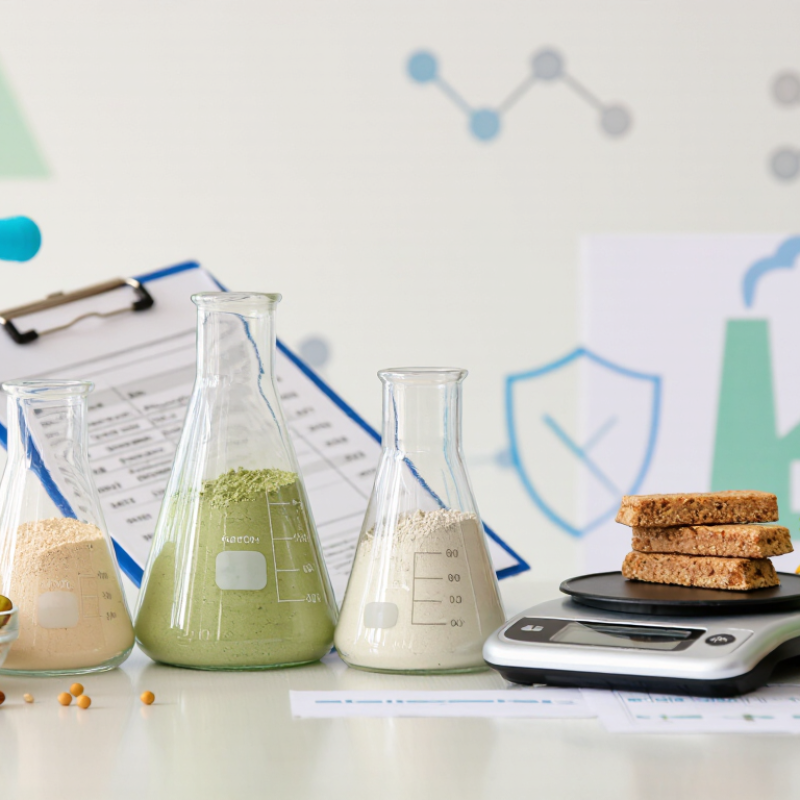
Before contacting a plant protein manufacturer, define the product on paper.
Specify the protein source, target protein percentage, serving size, flavor, color, texture, and intended use. Pea, rice, fava, and blended proteins behave differently in beverages, bars, and baked foods. Each choice affects solubility, taste, nutrition, and processing conditions.
Small details matter. State whether the powder must dissolve in cold water, remain stable after heating, or avoid a gritty mouthfeel. Include allergen controls, testing requirements, packaging format, shelf-life goals, and acceptable moisture levels. Reliable specifications should reference measurable methods, not vague terms such as “clean” or “premium.” Request certificates of analysis, microbiological results, heavy metal testing, and evidence of quality-system controls.
Test samples in the final recipe.
A laboratory sample can perform well in water but fail in a smoothie or nutrition bar. Ask the manufacturer for pilot batches and compare them under realistic storage conditions. Record mixing time, sediment, aroma, aftertaste, and batch consistency.
Our first specification was too broad, and the resulting samples exposed that weakness. We had overlooked flavor changes after heating. That mistake was useful. Revise the document after each trial, and clearly separate essential requirements from preferences. Manufacturers can solve defined problems more efficiently than unclear expectations.
Choosing a plant protein manufacturer requires more than comparing prices. Evaluate the team behind the equipment.
Ask how long the technical staff have handled legumes, grains, or oilseed proteins. Experienced specialists should explain extraction, drying, milling, and blending without vague promises. Request examples of difficult production problems they solved. Their answers can reveal practical knowledge.
A qualified manufacturer should also provide clear specifications, batch records, allergen controls, and microbial testing procedures. Check whether quality staff review results independently. Small details matter.
Production capability deserves equal attention. Visit the facility when possible. Observe material flow, cleaning routines, storage conditions, and production line maintenance. Ask about pilot batches before approving commercial volumes. A pilot run can expose poor solubility, unpleasant flavor, excessive foaming, or unstable texture. Review capacity at your expected order size, not only the maximum advertised capacity. Confirm lead times, minimum order quantities, packaging options, and traceability from raw material to finished goods. The manufacturer should explain how it manages deviations and product complaints.
I once focused too heavily on laboratory certificates. That was a mistake. Strong documents cannot replace consistent factory performance. Request recent, anonymized batch data and compare results across several production lots. Ask who approves raw materials and how supplier changes are communicated. Some manufacturers may hesitate to disclose weaknesses. Honest answers are more useful than polished presentations. A capable partner welcomes technical questions and admits where further testing is needed.
7 Tips for Choosing a Plant Protein Manufacturer
Tip 1: Verify ingredient identity before discussing price. Ask for current Certificates of Analysis, botanical names, country of origin, and processing details. Confirm protein content using a recognized testing method, not only a supplier’s specification sheet. Check amino acid profiles when nutritional claims matter. Small differences can affect formulation performance.
Tip 2: Review safety controls in detail. Request recent microbiological, heavy metal, pesticide, allergen, and mycotoxin results. Testing should match the ingredient’s risks and your target market. Traceability records should connect each batch to its source and production date. A clean-looking document can still hide weak sampling practices. Ask how samples were collected.
Tip 3: Confirm regulatory readiness before approving a supplier. Check whether the facility follows suitable GMP and HACCP systems. Verify food-contact materials, labeling data, allergen declarations, and permitted claims for each destination country. Independent audits can reveal gaps that certificates overlook. Do not treat a certificate as permanent proof.
Tip 4: Evaluate consistency through pilot batches. Compare color, flavor, solubility, texture, and odor across several lots. Keep retained samples for future investigation. A manufacturer may meet specifications while still producing an ingredient that performs poorly in your formula. That deserves a second review. Reliable communication matters, too. Ask how deviations, recalls, and complaints are documented. If answers remain vague, approval should wait.
A reliable plant protein manufacturer should pass all seven verification gates. Review ingredient identity and purity, testing documentation, allergen controls, food safety systems, traceability, regulatory labeling, and change-control procedures before approval.
7 Tips for Choosing a Plant Protein Manufacturer
Compare Formulation Support, Minimum Orders, and Costs
Choosing a plant protein manufacturer involves more than checking a price list. The right partner should show practical formulation experience, not only polished sales claims. Ask whether its team can adjust protein texture, flavor, solubility, and allergen controls for your product. Request a sample formula and the reasoning behind each ingredient. Details matter.
Minimum order quantities can reshape your launch budget. A low quoted cost may still require several thousand units, custom packaging, or paid pilot batches. Compare the full starting cost, including formulation fees, testing, freight, storage, and revisions. Ask what happens if the first sample fails. Will you pay again? Some manufacturers offer flexible pilot runs, but their unit price may be higher. That trade-off can be reasonable for a new product with uncertain demand.
For serious comparison, place each proposal in one spreadsheet. Record MOQ, price breaks, lead times, testing scope, certifications, and payment terms. Then check whether the documents match actual production practice. A facility tour or independent quality audit can reveal gaps that a brochure hides. I would not choose the cheapest quote automatically. Still, expensive support does not guarantee better results. One overlooked issue is communication speed. Slow replies can delay sensory trials and consume the budget. Leave room for mistakes; plant proteins often need several rounds before the texture feels right.
Compare formulation support, minimum orders, lead times, quality controls, and indicative costs before selecting a partner.
| # | Selection Tip | What to Compare | Typical Industry Benchmark | Cost or Risk Impact | Recommended Action |
|---|---|---|---|---|---|
| 1 | Evaluate formulation support | Assess whether the manufacturer provides ingredient selection, bench samples, flavor masking, texture optimization, nutrition-panel support, and stability testing. | Basic: sample preparation only. Standard: 1–3 formulation revisions. Advanced: dedicated food-science support with pilot trials. |
Formulation fees commonly range from US$500–US$5,000, depending on complexity. Strong support can reduce reformulation and launch delays. | Request a written development scope, number of included revisions, sample quantities, and ownership terms for the final formula. |
| 2 | Check minimum order quantities | Compare minimums for bulk powder, finished product, custom blends, stick packs, tubs, and private-label packaging. | Pilot runs: approximately 25–100 kg. Small commercial runs: approximately 250–1,000 kg. Large-scale runs: 2,000 kg or more. |
Lower MOQs may increase the unit cost by roughly 10%–35% because setup, testing, and packaging costs are spread across fewer units. | Choose an MOQ that matches forecasted sales and shelf-life constraints rather than selecting the lowest quoted unit price. |
| 3 | Compare total landed cost | Review protein base, flavors, sweeteners, functional ingredients, blending, packaging, testing, freight, tariffs, and payment terms. | Indicative bulk plant-protein powder pricing is often around US$4–US$12 per kg for common proteins, before custom formulation and packaging. | Finished retail-ready products may reach approximately US$8–US$25 per kg, depending on protein type, claims, pack format, and order volume. | Request a line-item quotation and compare the final cost per sellable unit, not only the ingredient or powder price. |
| 4 | Verify quality and certifications | Check current third-party audits, HACCP or preventive-controls systems, allergen management, traceability, sanitation procedures, and relevant organic or non-GMO certifications. | Established facilities typically provide lot traceability, certificates of analysis, allergen declarations, and documented corrective-action procedures. | Additional certifications or segregated production can add approximately 3%–15% to manufacturing costs but may be necessary for market access. | Ask for current certificates, audit dates, sample COAs, allergen-control procedures, and the process for handling nonconforming batches. |
| 5 | Confirm testing and documentation | Compare testing for protein content, microbiology, heavy metals, pesticides, allergens, moisture, identity, and contaminant risks relevant to the raw materials. | Routine lot-release testing commonly takes 3–10 business days; expanded testing may require additional laboratory time. | Standard testing may cost about US$150–US$800 per lot; specialized contaminant or claim verification can cost more. | Define required tests, acceptance limits, testing frequency, approved laboratories, and document delivery before production begins. |
| 6 | Assess capacity and lead times | Review pilot capacity, monthly production capability, ingredient availability, packaging supply, production scheduling, and contingency planning. | First custom order: commonly 8–16 weeks. Repeat orders: commonly 4–10 weeks, subject to materials and packaging availability. |
Rush production may add approximately 10%–25% and can increase the risk of ingredient substitutions or packaging delays. | Obtain a milestone-based timeline covering formulation approval, purchasing, production, testing, release, and shipment. |
| 7 | Review packaging and scalability | Compare capabilities for sachets, pouches, tubs, bulk bags, filling accuracy, coding, labeling, case packing, and future volume increases. | Packaging setup charges often range from US$300–US$2,500; printed packaging may require several weeks and minimum runs of approximately 1,000–10,000 units. | Custom packaging can add roughly US$0.20–US$2.00 per unit, depending on materials, size, printing, and order volume. | Confirm packaging specifications, artwork requirements, line speed, overfill tolerances, storage conditions, and the cost impact of scaling production. |
Note: Cost ranges and lead times are indicative industry benchmarks for planning purposes. Actual figures vary according to protein source, formulation complexity, packaging format, location, certification requirements, order volume, and testing scope.
A reliable plant protein manufacturer must prove more than product quality. It must scale without weakening communication or supply control. The Good Food Institute’s 2023 State of the Industry report valued global plant-based retail sales at nearly $30 billion. That growth increases pressure on manufacturers, especially during sudden demand increases.
Tip: Ask for capacity evidence. Request current monthly output, spare capacity, lead times, and expansion plans. A factory should explain what happens when an order doubles.
Tip: Test scalability through a controlled pilot. Review batch records, yield changes, staffing, and quality results. Larger equipment does not always deliver consistent texture.
I learned this after trusting impressive machinery too quickly.
Tip: Set communication rules early. Define response times, escalation contacts, and weekly production updates.
Tip: Audit supply reliability beyond the factory gate. Check backup suppliers for protein isolates, oils, packaging, and transport. The Food and Agriculture Organization highlights climate and logistics risks across food supply chains, so one-source purchasing deserves careful questioning.
Tip: Request recent on-time delivery data, not promises.
Tip: Verify food safety systems, traceability, and independent audit results.
Tip: Run a stress test using a delayed shipment or raw-material shortage. Watch how openly the team responds. Their reaction may reveal more than a polished presentation.
Mistakes still happen. The real test is whether the manufacturer reports them quickly and corrects them with evidence.
Ask how long the technical team has handled legumes, grains, or oilseed proteins. Request examples of difficult production problems they solved. Vague answers deserve caution.
Request clear specifications, batch records, allergen controls, and microbial testing procedures. Check whether quality staff review results independently. Small details matter.
A visit can reveal material flow, cleaning routines, storage conditions, and equipment maintenance. Observe how workers handle production areas. Visit if possible.
Pilot batches can expose poor solubility, unpleasant flavor, excessive foaming, or unstable texture. Test before approving commercial volumes. One sample may not reveal everything.
Confirm capacity at your expected order size, not only the maximum advertised capacity. Ask about lead times, minimum orders, packaging, and traceability. Also discuss deviations and complaints.
Ask whether the team can adjust texture, flavor, solubility, and allergen controls. Compare formulation fees, testing, freight, storage, and revisions. The cheapest quote may not be cheapest overall.
Use one spreadsheet for minimum orders, price breaks, lead times, testing scope, certifications, and payment terms. Check whether documents match actual factory practices. A brochure can hide gaps.
Ask what happens if the first sample fails and whether further testing is needed. Honest answers are more useful than polished presentations. Slow replies can delay sensory trials. I once trusted certificates too much. That was a mistake.
Choosing the right plant protein manufacturer begins with clearly defining your product requirements, including protein source, flavor, texture, nutrition targets, format, packaging, and intended market. Buyers should then evaluate each manufacturer’s technical expertise, processing equipment, quality systems, and ability to produce consistent products at the required scale. A reliable partner should also provide transparent information about ingredient origins, testing procedures, allergen controls, certifications, and compliance with applicable food regulations.
When considering what should buyers look for in a plant protein manufacturer, it is important to compare more than just the quoted price. Review formulation support, sample development capabilities, minimum order quantities, lead times, and total production costs. Communication, flexibility, and supply reliability are equally important, especially when demand changes or product lines expand. By assessing quality, innovation, operational capacity, scalability, and customer support together, buyers can select a manufacturer that supports both successful product development and long-term business growth.
